Best Platforms to Sell AI Agent Skills [2026]
Where to sell AI agent skills in 2026: SkillSafe (metered runs, 0% on your markup), skills.sh (reach), GitHub (source), Gumroad-style stores (10% + $0.50).
Four channels can carry an agent skill to buyers: SkillSafe, skills.sh, a plain GitHub repo, and a Gumroad-style digital store. Only one of them meters usage and gives non-developers a runtime. Gumroad charges 10% + $0.50 per direct sale; SkillSafe takes 0% of your markup. Here is the comparison.
Updated September 2026: Gumroad’s published fee is 10% + $0.50 on a direct sale and 30% on a sale that comes through its Discover marketplace; SkillSafe’s platform cut on a publisher’s markup is still 0%. The rest of the guidance below is unchanged.
The install side of the market has settled on one command. Vercel’s open-source skills CLI (npx skills add <source>) installs a skill into Claude Code, Cursor, Codex and OpenCode from any git source, and enterprise registries — JFrog’s Agent Skills Registry among them — now version and govern the same SKILL.md format. The full reference for that command covers the eight source formats it resolves and where the files land. Distribution is solved. Getting paid is not.
Key figures
| Figure | What it measures | Source |
|---|---|---|
| 10% + $0.50 | Gumroad’s fee on a direct sale | Gumroad pricing |
| 30% | Gumroad’s cut when the buyer arrives via its Discover marketplace | Gumroad pricing |
| 2.9% + $0.30 | Stripe’s standard fee per successful domestic card charge, if you build checkout yourself | Stripe pricing |
| 0% | Share of your app markup SkillSafe keeps — no listing fee, no sales fee, no payout fee | SkillSafe pricing |
| 10% | Platform margin SkillSafe charges on a run’s compute cost (not on your side) | Model catalog |
| 0–100% | Markup range a publisher can set on runs | SkillSafe pricing |
| 10,000 | Credits per US dollar; a run settles to the exact cent | SkillSafe pricing |
| $25 | Earnings threshold before you can request a payout | SkillSafe pricing |
| 14 days | Maturity window before an earning becomes redeemable | SkillSafe pricing |
| 100 / 2,000 | Hosted apps allowed on Free / Pro | SkillSafe pricing |
| 3,984 | Agent skills Snyk analysed across ClawHub and skills.sh | Snyk ToxicSkills |
| 36.82% | Of those skills carried at least one security issue | Snyk |
| 1,184 | Malicious skill packages catalogued in the ClawHavoc campaign | Antiy CERT |
Those last three figures are the reason the trust column below is not decoration. A buyer deciding whether to run your skill is deciding it in a market where roughly a third of published skills have something wrong with them.
The Problem: Skills Don’t Sell Themselves
A good skill takes real work — prompt engineering, edge-case handling, reference files, iteration against actual agent behavior. Then it ships as a folder of markdown and scripts, and the market for folders of markdown is brutal: GitHub stars don’t convert to income, and the people who’d pay the most (non-developers who just want the capability) can’t install a skill at all.
Selling a skill means solving four problems at once:
- Distribution — being findable by people searching for the capability.
- Trust — a stranger has to run your code inside their agent, with their credentials nearby. “Trust me” doesn’t scale; scanning and verification do.
- Payments — metering, checkout, refunds, payouts. Building this yourself is a bigger project than most skills.
- Audience — developers can install a skill file; everyone else needs it packaged as something they can click.
Quick Comparison
| SkillSafe | skills.sh | Plain GitHub | Generic marketplaces (Gumroad-style) | |
|---|---|---|---|---|
| Distribution | Skill directory + app directory, category/tag search | Trending index, CLI install | Search + stars, no skill-specific discovery | Storefront, no agent-skill audience |
| Security scanning | Every shared skill scanned; dual-side verification on install | None | None | None |
| Built-in payments | Usage markup (0–100%), kept in full | None | None (Sponsors ≠ sales) | One-off file sales |
| Hosted runtime | Yes — skill becomes an app at your-slug.skillsafe.ai | No | No | No |
| Audience | Developers and anyone with a browser | Developers only | Developers only | Buyers can pay, then can’t run it |
| Fees | 0% on your markup | — | — | 10% + $0.50, or 30% via Discover |
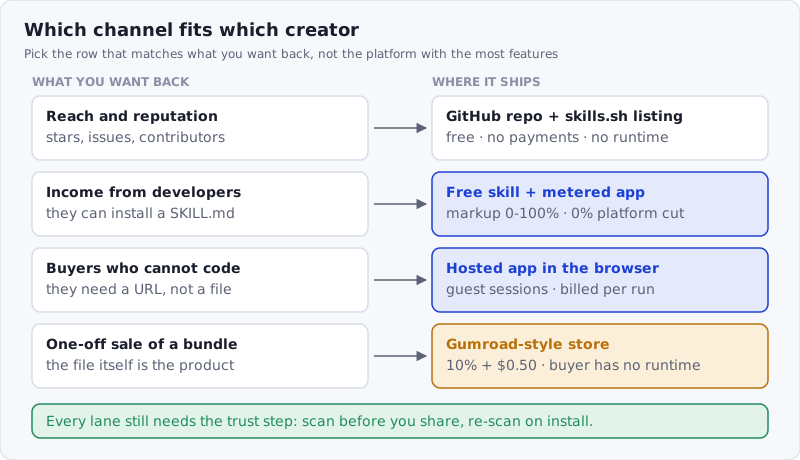 Figure: the channel follows from what you want back — reach, revenue, or a buyer who cannot install a skill file.
SkillSafe: Skill to Hosted App With Billing Built In
SkillSafe treats the skill file as the starting point, not the product. You share the skill free — it gets scanned, listed, and installable via npx skills add or the desktop app — and then, when you want revenue, the same SKILL.md becomes the system prompt of a hosted app that anyone can run in a browser.
The monetization stack is the differentiator, because you write none of it: runs are metered in credits at actual token cost (billed at the rates on the model catalog) and you add a markup of up to 100% on top. The platform handles user accounts, guest sessions, holds and refunds, and payouts — and you keep 100% of your markup, with no fee deducted from it. Earnings mature after 14 days and are redeemable in dollars once you clear $25, by PayPal or USDC. The full mechanics are in How to Charge Users for an AI App Without Stripe.
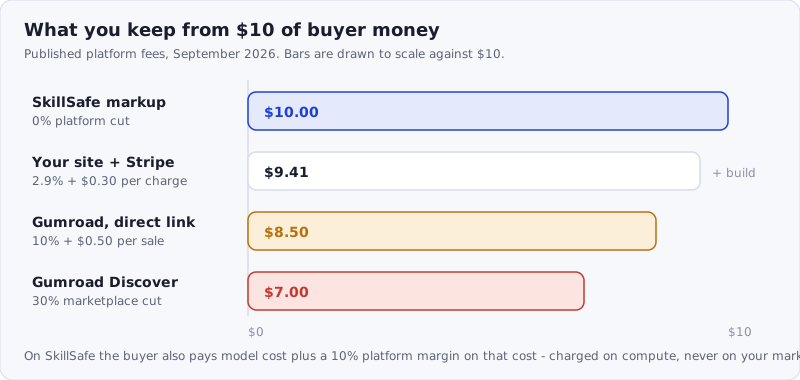 Figure: on $10 of buyer money, the platform cut is the whole difference — and on SkillSafe the cut lands on compute, not on your markup.
The trust problem is handled structurally rather than socially: every shared skill passes a security scan, installs are re-scanned and cryptographically compared against the publisher’s report, and every public app must pass a clean scan — skill and frontend — before it’s listed. That comparison step is the subject of How Dual-Side Verification Works.
Best for: creators who want the skill itself to earn — especially from users who don’t code.
skills.sh: Distribution Without Monetization
skills.sh is the leaderboard: a trending index of skills across the ecosystem with a one-line install. It’s genuinely good at surfacing what’s popular, and if your goal is reach among developers, being on it costs nothing and helps. Since Vercel opened the skills.sh API, other tools can read that index programmatically, which widens the funnel further.
What it doesn’t have is everything after discovery: no scanning, no verification, no payments, no runtime. It answers “what’s hot” — not “is this safe” or “how do I get paid.” Treat it as top-of-funnel, not a store. (SkillSafe indexes skills.sh install counts, so popularity there carries over; the supply-chain implications of that API are covered in The skills.sh API Changes the Supply Chain.)
Best for: free distribution and developer mindshare.
Plain GitHub: Free, Flexible, Invisible
A public repo is where most skills start and where most skills stay. You keep full control, and for open-source-first creators that’s the point. But as a sales channel it fails all four tests: discovery is generic code search, trust is your README’s word, payments are a Sponsors link that converts at hobby rates, and the audience is exclusively people comfortable cloning repos into their agent config.
GitHub is the workshop, not the storefront. Every other option here happily coexists with it — SkillSafe imports from GitHub and links back to the source repo, and the skills CLI installs from any git URL, including ours.
Best for: development, issues, and open-source credibility — alongside a real distribution channel.
Generic Digital Marketplaces: Payments Without an Agent Runtime
You can sell a skill as a zip file on a Gumroad-style marketplace. Checkout works, at 10% + $0.50 per direct sale — 30% if the buyer found you through Discover. Everything else doesn’t: there’s no audience searching for agent skills, no way for buyers to preview behavior, no scanning (you’re asking someone to pay first and then run unaudited code in their agent), no updates channel, and no runtime — a buyer who doesn’t use Claude Code or Cursor bought a file they can’t execute.
One-off file sales also fight the economics of AI: your buyer’s costs scale with usage, so flat pricing either overcharges or underprices. Usage metering fits the product; file sales don’t.
Best for: almost nothing skill-shaped, honestly — bundled courses or template packs where the file is the product.
Which Platform Fits Which Creator
- You want reputation and reach, not revenue → GitHub + skills.sh, and share it free on SkillSafe for the scan badge.
- You want passive income from a skill developers love → SkillSafe with the skill shared free and the app priced at a modest markup — the walkthrough is in How to Monetize a Claude Code Skill.
- You want to sell to non-developers → a hosted app is the only real option on this list; nothing else gives buyers a runtime.
- You’re selling a course or bundle about skills → that’s a digital-goods sale; a generic marketplace is fine.
Frequently Asked Questions
Can you actually make money selling Claude Code skills?
Not by selling the file — by selling runs of it. A skill is a text artifact that copies for free, so the durable model is metered execution: the skill becomes a hosted app, each run bills the model cost plus your markup of up to 100%, and you keep 100% of that markup. Earnings clear after 14 days and pay out above $25.
What does it cost to run a paid skill app?
Runs are billed at provider list price plus a 10% platform margin plus your markup — both cuts figured on the same compute cost, metered per token. Per-model rates are on the model catalog, and worked examples are in What It Costs to Run an AI App on SkillSafe. New users get free signup credit, so trying your app costs them nothing.
Do I have to make my skill public to sell an app?
No. The skill can stay unlisted — apps are built from a snapshot of your saved skill. Public listing of the app itself requires a clean security scan of both the skill and the app frontend. Free accounts can host up to 100 apps; Pro raises that to 2,000.
Is it cheaper to sell directly with my own site and Stripe?
On paper: Stripe’s standard fee is 2.9% + $0.30 per charge, cheaper than a 10% marketplace. In practice you also build metering, accounts, holds, refunds, fraud handling and an audience from zero. If the skill is the product rather than a feature of a bigger SaaS, that work usually outweighs the fee savings — the math is in How to Charge Users for an AI App Without Stripe.
Where do developers find agent skills in 2026?
Three places: the trending index at skills.sh, searchable registries like the SkillSafe skill directory and JFrog’s Agent Skills Registry, and GitHub repos installed directly with npx skills add. Publishing to more than one costs nothing, because all three read the same SKILL.md format.
Conclusion
Distribution, trust, payments, audience — pick the platform that solves the ones you can’t solve yourself. GitHub and skills.sh remain the right answer for free reach among developers. The moment money enters the picture, the field narrows to whoever can meter usage and give non-developers a way to run your work — and in 2026, for agent skills specifically, that’s SkillSafe. Share the skill free, ship it as an app, set your price, and let the repo keep earning stars while the app earns revenue.
Related roundups: Browse all Best Of roundups