Streamlit Cloud vs Hugging Face Spaces vs Custom GPTs vs SkillSafe Apps (2026)
No single winner: Streamlit for Python data apps, Spaces for GPU model demos, custom GPTs for ChatGPT-native bots, SkillSafe Apps for metered agent skills.
There is no single winner: each platform fits a different artifact. A Python script belongs on Streamlit Community Cloud (2.7 GB of RAM, free). A model demo belongs on Hugging Face Spaces (free 2 vCPU / 16 GB CPU tier, GPUs from $0.40/hour). A prompt belongs in a custom GPT. An agent skill belongs on SkillSafe Apps.
Updated September 2026: every limit and price below was re-checked against vendor documentation. All four are unchanged.
The comparison at a glance
| Streamlit Community Cloud | Hugging Face Spaces | Custom GPTs | SkillSafe Apps | |
|---|---|---|---|---|
| You deploy | A Python Streamlit app from a GitHub repo | Gradio / Streamlit / Docker / static apps | Instructions + knowledge files + API actions, configured in ChatGPT | An agent skill (its SKILL.md becomes the app’s system prompt) |
| Users need | A browser | A browser (some features want an HF account) | A ChatGPT account, with usage caps on the free tier | A browser — guest access, no account |
| Free compute | 0.078–2 CPU cores, 690 MB–2.7 GB RAM, up to 50 GB storage | CPU Basic: 2 vCPU, 16 GB RAM | OpenAI models, capped by the user’s ChatGPT plan | Metered per run; owner can sponsor guest runs |
| Bring your own model key? | Yes — you supply and pay for inference | Your code, your inference (free CPU tier; GPUs from $0.40/hour) | No — runs on OpenAI models only | No — Claude, GPT, and Workers AI models included, metered per run |
| Charge your users | Not built in | Not built in for end-user billing | Limited builder payouts (US-only, engagement-based) | Credit metering, up to 100% markup, kept in full |
| Security review of listings | None | None | Store review, criteria not security-focused | Skill + frontend must pass a clean security scan before public listing |
| Best for | Python data apps, internal dashboards | ML model demos, GPU inference | ChatGPT-native chatbots, zero build effort | Agent skills turned into metered products |
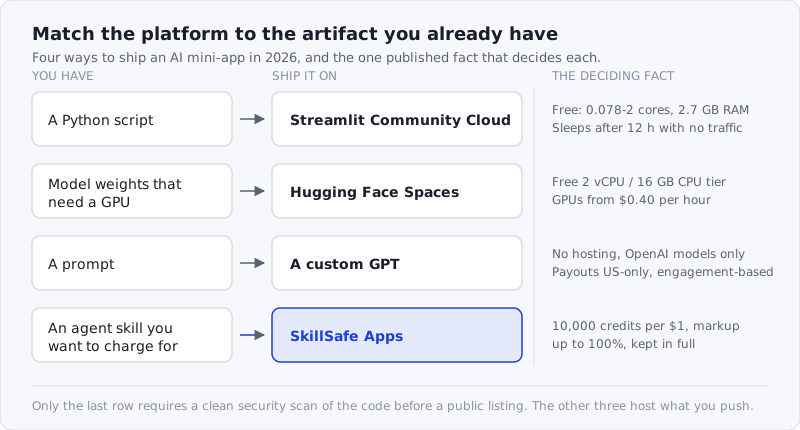
Figure: start from the artifact you already have. Cross-graining — rewriting a skill as a Streamlit app, or wrapping GPU weights in a chat interface — costs more than any platform difference.
Streamlit Community Cloud
The default answer for “I have a Python script and want a UI on it today.” Deploy from a public GitHub repo, get a shareable URL, and the widget library carries most data-app needs without frontend work.
The limits are published, which is more than most free tiers manage. Each app gets between 0.078 and 2 CPU cores, between 690 MB and 2.7 GB of memory, and up to 50 GB of storage, per Streamlit’s own resource table. Two operational rules matter more than the numbers:
All apps without traffic for 12 hours go to sleep.
— Streamlit Community Cloud documentation, “Manage your app”
The second is that app updates from GitHub are rate limited to five per minute, and every Community Cloud app runs in the United States with no region control. Beyond that: it’s Python-or-nothing, and there is no built-in way to charge users or give them accounts — you bring (and pay for) your own model API keys. For an internal tool or a portfolio demo, none of that matters. For a product, all of it does.
Hugging Face Spaces
The home of ML demos. If your app is a model — you need GPU inference, you’re showing off weights, you want the ML community to find it — Spaces is where that audience already browses. A Space is a git repo with an SDK declaration: Gradio, Streamlit, Docker, or a static site, per the Spaces overview.
The free CPU Basic tier is 2 vCPU and 16 GB of RAM, which gets you surprisingly far. Paid hardware starts at $0.40/hour for an Nvidia T4 small and scales up from there; a PRO account is $9/month and carries 8x the ZeroGPU quota plus queue priority (Hugging Face pricing). Weaknesses mirror Streamlit’s: no end-user billing primitives, discovery is skewed toward the ML crowd rather than general users, and you own the inference bill for anything popular — an always-on T4 is about $288 a month before anyone pays you anything.
Custom GPTs
The lowest-effort path on the list: configure instructions, upload knowledge files, add API actions described by an OpenAPI schema, publish to the GPT Store — no code, no hosting.
Distribution inside ChatGPT is the killer feature and the cage. The store launched on January 10, 2024 behind ChatGPT Plus, Team and Enterprise plans, with free-tier access following in May 2024. Your users must be ChatGPT users (free-tier users hit usage caps), your app cannot exist outside that interface, and you are limited to OpenAI models. Builder monetization has remained what TechCrunch described at launch — a US-only program paying builders based on “user engagement” — rather than the per-transaction billing a product needs. If your audience lives in ChatGPT and you want a presence there this afternoon, it’s the right tool.
SkillSafe Apps
The wedge is different: you start from an agent skill — the same SKILL.md you built for Claude Code or Cursor — and deploy it as a hosted app at https://your-slug.skillsafe.ai/ with one prompt to your agent.
What the platform adds is the product layer the other three lack: guest access with no account, one-click sign-in, per-app data collections and file storage, included models (Claude, GPT, Workers AI) so users never bring a key, and usage-metered billing with no payment integration. The unit is fixed: $1 buys 10,000 credits, a run is priced from the provider’s list cost, and the owner sets a markup of up to 100% and keeps all of it — the platform fee on markup is 0%. Storage comes from one pooled quota: 50 MB free, 10 GB on Pro. Every public listing requires the skill and frontend to pass a clean security scan, which is the trust angle none of the others attempt.
Weaknesses, honestly: you author behavior as a skill plus a declarative frontend, not arbitrary Python — a custom widget-heavy UI is Streamlit’s territory; there’s no GPU runtime for your own weights — that’s Spaces; and the directory is young, so nobody should pick it for built-in audience size yet. Pick it when the thing you have is a skill and the thing you want is a product. The mechanics are in How to turn a Claude Code skill into a web app.
Verdicts by use case
- Internal dashboard or Python data tool → Streamlit Community Cloud.
- Model demo, GPU inference, ML-community distribution → Hugging Face Spaces.
- Chatbot for people already in ChatGPT, zero build → custom GPT.
- Agent skill you want non-developers to use — and pay for → SkillSafe Apps.
- Honorable mentions: Poe’s creator program (chat bots with per-use payouts), Gradio (the library powering many Spaces), and val.town (hosted functions) all solve adjacent problems.
Frequently Asked Questions
What’s the best platform to deploy AI mini apps in 2026?
Match the platform to the artifact you already have. A Python script wants Streamlit; a model wants Spaces; a prompt wants a custom GPT; an agent skill wants SkillSafe Apps. Cross-graining — forcing a skill into a Streamlit rewrite, or a GPU model into a chat wrapper — costs more than any of the 4 platforms’ differences.
Is there a GPT Store alternative for Claude?
SkillSafe Apps is the closest equivalent for the Claude ecosystem: skills written for Claude Code deploy as hosted apps that run on Claude models (Haiku, Sonnet, or Opus per app), are discoverable in a public directory, and — unlike the GPT Store, which has paid US builders on engagement since 2024 — pass a security scan before listing and meter end-user billing at 10,000 credits per dollar from day one.
Can I charge users on Streamlit Cloud or Hugging Face Spaces?
Not natively — neither platform has end-user billing primitives, so charging means wiring up Stripe, accounts, and metering yourself on top of your app. Spaces will happily bill you $0.40/hour for a T4 while your users pay nothing. If monetization is the point, start from a platform that meters usage for you; the mechanics are covered in How to Charge Users for an AI App Without Stripe.
How do I turn a Claude Code skill into a web app?
Point your agent at the skill directory and ask it to deploy: the SKILL.md becomes the app’s system prompt, and the platform supplies the frontend, guest access, storage and metering. There is no build step and no Dockerfile. The 5-step walkthrough is in How to turn a Claude Code skill into a web app; to sell the skill itself instead, see how to monetize a Claude Code skill.
Do these platforms review what they host?
Only one of the 4 checks for malicious code. Streamlit and Spaces run whatever is in the repo; the GPT Store reviews listings against usage policies, not for supply-chain risk. SkillSafe requires a clean scan of the skill and frontend before a public listing — background in our MCP and agent security guide.